
ram-air simulation
Performance Measurement 2.0
Ram-air simulation fan
What happens to a superbike’s engine power when additional air flows through the ram-air intake at high speed? And how can this effect be investigated under controlled conditions on a motorcycle dynamometer?
With our newly developed P4 Ram-Air simulation fan, we are opening up entirely new possibilities for professional performance measurement, engine development and the tuning of high-performance motorbikes.
At the heart of our design is a high-performance fan with a 30 kW motor and a speed of up to 20,000 revolutions per minute.
With an air velocity of over 300 km/h, this is the first time in this performance class that it has been possible to specifically simulate the airflow generated by modern superbikes on the test bench and direct it straight into the ram-air intake. A high-cost frequency converter adjusts the air outlet velocity to match the motorcycle’s riding speed as determined on the test bench.
This means that, for the first time, the flow conditions in the intake system – as they occur whilst the vehicle is in motion – can be specifically investigated on the test bench using our P4 technology.
Designed to meet the highest standards in professional motorbike tuning, ECU mapping and motorsport.
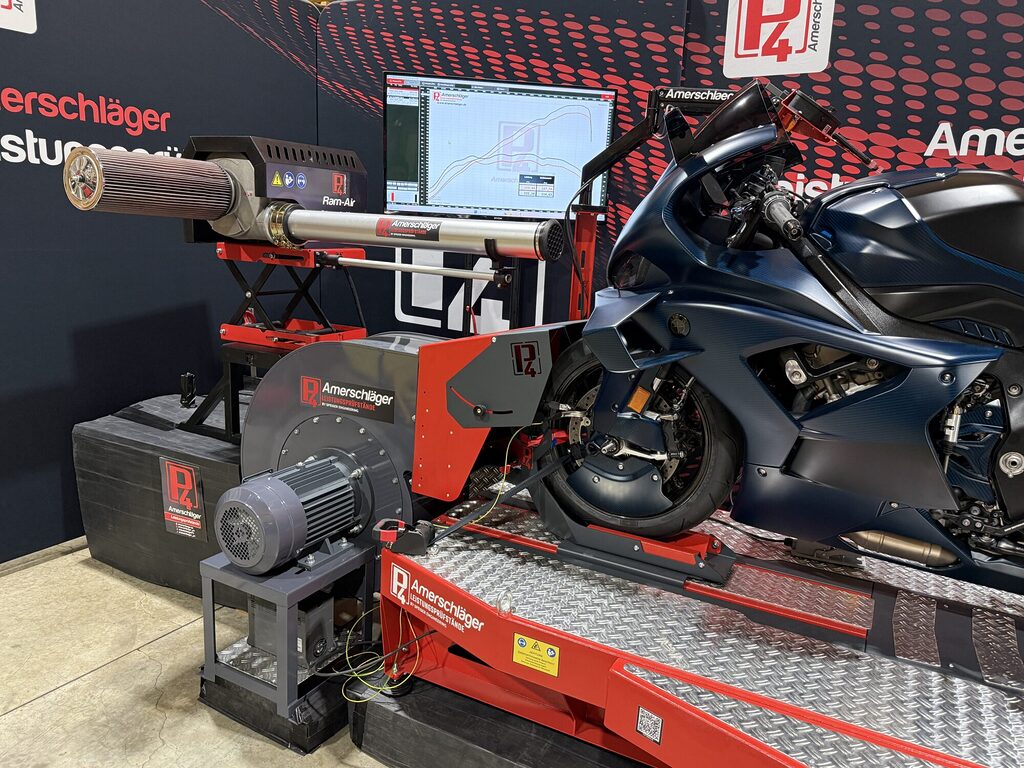
Why carry out ram-air simulation on the test bench?
Modern superbikes such as the BMW S/M1000RR, Ducati Panigale, Kawasaki ZX-10R, Honda CBR and the Yamaha YZF-R1/6 are fitted with ram-air intake systems.
Whilst riding, air flows through the intake vents in the motorcycle’s fairing and is channelled via intake ducts to the airbox. At high speeds, this creates additional dynamic pressure, which affects the cylinder filling and, consequently, the engine’s performance.
The problem with conventional performance measurement:
On a stationary motorcycle dynamometer, the airflow to the ram-air intake caused by the actual riding speed is largely absent. Conventional cooling fans mainly supply the motorbike with cooling air. However, they are not designed to generate an intense airflow directed specifically at the ram-air inlet in order to investigate the ram-air effect.
Consequently, conventional test bench measurements fail to take into account an important factor influencing engine performance. This is precisely where our new development comes in.
The new P4 ram-air simulation fan allows the airflow to be directed specifically towards a motorbike’s air intake. The high-performance fan generates a powerful airflow for this purpose. The controlled airflow allows the effects of the ram-air effect to be investigated under test bench conditions. This makes it possible to carry out power measurements with and without additional ram-air flow and to compare the results directly with one another.
This opens up interesting new possibilities for the analysis and optimisation of modern high-performance motorbikes.
Technical specifications of the P4 Ram-Air Simulation fan
- An airspeed of over 300 km/h
- 30 kW engine power
- 400-volt supply voltage
- 32 ampere current rating
- 20.0000 revolutions per minute
BMW S1000RR on the dynamometer: Just how many PS does RAM-AIR really deliver?
To demonstrate the potential of our new Ram-Air simulation, we tested a BMW S1000RR on our P4 dynamometer.
In doing so, we compare two measurements:
Measurement 1 – without ram-air simulation
The BMW S1000RR is tested on the dynamometer without any additional airflow, using the ram-air simulation fan.
Measurement 2 – using a ram-air simulation
In the second test, the BMW S1000RR’s ram-air intake is specifically exposed to the airflow from our new high-performance fan.
The subsequent comparison of the performance curves reveals the extent to which the additional airflow, under the selected test conditions, influences the measurement results.
More than just a cooling fan
At an airspeed of over 300 km/h, a whole new dimension in power measurement is achieved. Conventional test bench fans are primarily used to supply the motorbike with cooling air during power measurement.
Our P4 Ram-Air simulation blower takes a completely different approach. The focus is on directing an extremely powerful airflow specifically at the ram-air intake. This allows the effects of high riding speeds on engine performance to be investigated under controlled test bench conditions. With a motor output of 30 kW, up to 20,000 rpm and an air velocity of over 300 km/h, our development sets new standards in professional performance measurement for motorbikes.
This allows the airflow conditions that occur at high speeds on the racetrack to be specifically simulated, and their impact on engine performance to be analysed. The P4 Ram-Air Simulation Blower extends conventional performance measurement to include the crucial factor of airflow through the intake system.
Who is our ram-air simulation fan suitable for?
For professional tuning workshops
Investigate how an additional ram-air flow affects the power curve. Compare different configurations and gain further insights into the targeted optimisation of high-performance engines.
For ECU mapping and tuning specialists
Analysise the effects of changes in intake conditions on engine operation. In conjunction with suitable measurement technology, factors such as lambda values, air-fuel mixture preparation and airbox pressure can be included in the assessment.
For racing teams and motorsport developers
Expand your test bench trials to include a key influencing factor: the airflow through the ram-air system. Investigate modifications to the intake system and compare their effects under defined test conditions.
For professional test bench operators
Expand your range of services to include a specialised testing facility for modern high-performance motorbikes and create added value for discerning customers.


